
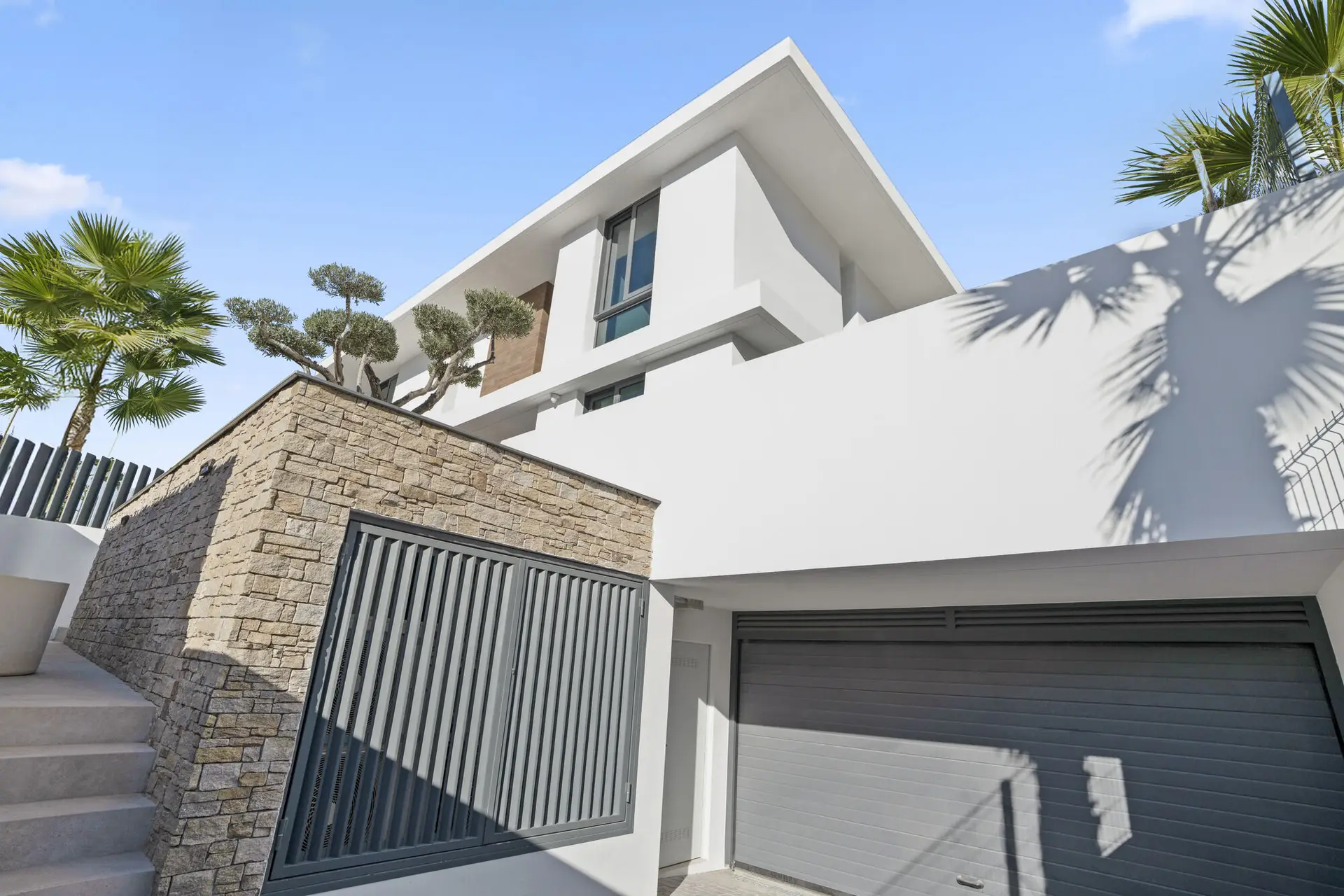
Buyers spending €1–3M on a villa on the Costa Blanca tend to ask about privacy and security early, often before they ask about kitchens. The answer depends less on the postcode than on the plot, the way the house meets the street, and the systems behind the walls. Some of it is also regulated: in Spain, an outdoor camera or an alarm connected to a monitoring centre comes with legal rules that many owners only learn about after installation.
This guide sets out what to check when you view a villa, how Spanish law treats alarms and cameras, what home insurers expect when the house stands empty, and how a new build compares with a resale. Where we refer to Villas de Loix, our development in Benidorm, we stick to the published specification.

Detached plot or gated estate
The first choice is structural. A detached villa on its own plot puts security in your hands: walls, gate, alarm and who has a key. A gated estate adds a shared perimeter and, on some estates, a staffed entrance, paid through community fees and governed by community rules. Neither is automatically safer. A guarded gate does little if the back of the estate opens onto a hillside path, and a well-designed detached villa on a residential street can be very hard to approach unseen.
| Option | Who controls security | Privacy | Things to check |
|---|---|---|---|
| Detached villa on its own plot | You: gate, perimeter, alarm, contracts | Depends on plot size, walls and what overlooks it | Boundary height, approach from the street, neighbouring windows |
| Villa on a gated estate | The community, plus your own systems | Shared roads and facilities; rules on fences and cameras | Guard hours, community statutes, fees, weak points in the perimeter |
| Penthouse or apartment | Building access plus your front door | Neighbours above, below and alongside | Concierge, lift access, terrace overlooking |
Sight lines, neighbours and the plot
Privacy is mostly geometry. On a viewing, stand in the garden, by the pool and on each terrace, and look for windows that can see you. On a hillside, the plot above matters more than the plot beside. In Benidorm, check the line to the nearest tower blocks as well: the town’s high-rise skyline is a real trade-off for villa owners, and orientation and planting decide whether you see it, and whether it sees you.
Points to note on every viewing:
- How the house meets the street: one vehicle gate and one pedestrian door is easier to control than an open drive.
- Boundary walls and hedges on all sides, including the back, where intruders usually try first.
- External lighting and whether the garden has dark corners.
- Whether a car can be put away out of sight, ideally with access straight into the house.
- Paths, empty plots or public land behind the boundary.
Our guide to luxury villas for sale on the Costa Blanca compares the main villa areas. The villas below are all detached, each on its own plot of 500 m² or more.
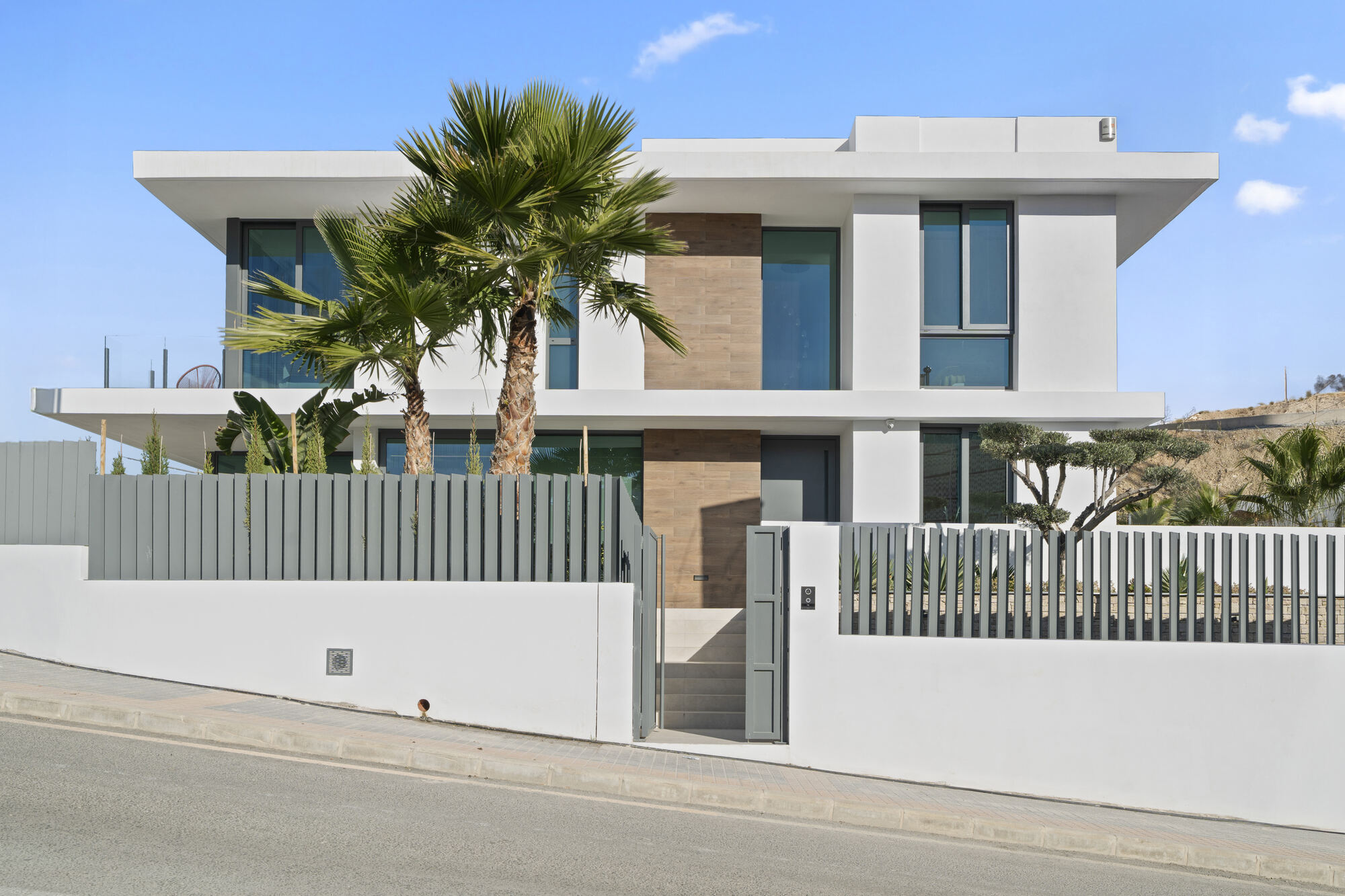
Detached villas on private plots in Rincón de Loix


Alarms connected to a monitoring centre
Most owners who spend months away want an alarm that calls someone. In Spain, an alarm connected to a central receiving station (central receptora de alarmas, CRA) counts as private security. Under Ley 5/2014 de Seguridad Privada only registered private security companies may install, maintain and monitor those systems, and installation needs accredited technicians.
The technical rules are in Orden INT/316/2011:
- Homes connected to a CRA need equipment of at least Grade 2 under UNE-EN 50131.
- The centre must verify each alarm before calling the police. Sequential verification needs three or more signals from different detectors within 30 minutes; video and audio verification are the alternatives.
- A phone call to the owner can never confirm an alarm on its own.
- Diallers that call the police directly are not allowed.
In practice, ask any installer for its registration number, the grade of the equipment and how verification works. A system that only sounds a siren is not regulated in the same way, but nobody may respond to it while you are abroad.
Cameras and data protection: what the AEPD allows
Outdoor cameras are where owners most often get it wrong. Article 22 of Spain’s data protection law, Ley Orgánica 3/2018, allows images of the public road only to the extent strictly necessary for security. The data protection authority’s practical sheet for homeowners (AEPD, cameras to protect my home) spells it out:
- No images of the public street, except a minimal strip at the entrances to the house where essential.
- No images of neighbouring plots or houses.
- Cameras that pan or zoom need privacy masks.
- A visible sign at the entrances to the monitored area, naming the person responsible and how to exercise data rights.
- Recordings deleted within one month, password-protected access, and a record of processing activities.
Cameras that film only the inside of your own home fall under the household exemption. That exemption does not cover a security company you hire that has access to the images, and when cameras are linked to a CRA the company becomes responsible for them (AEPD video surveillance guide). If footage records a crime, it must be given to the authorities within 72 hours.
Set camera angles with the installer on day one and keep a note of what each camera covers. A camera pointed at the street or a neighbour’s garden can lead to a complaint to the AEPD, and the burden is on you to show the angle was necessary.
Insurance when the house is empty
Home insurance in Spain treats second homes differently, and the limits sit in each insurer’s policy wording rather than in one national rule. Three examples from published conditions:
- SegurCaixa Hogar excludes jewellery and cash not kept in a safe once the home has been empty for more than 96 consecutive hours, and excludes theft of cash in second homes (policy clauses).
- Ibercaja’s home policy, underwritten by Caser, does not cover theft of jewellery, valuables or cash in second homes (policy document).
- ING’s home policy excludes most claims, other than fire, explosion and lightning, for homes lived in less than 15 days a year (general conditions).
Spain’s insurance contract law requires limiting clauses to be highlighted and accepted in writing (Ley 50/1980, art. 3), so read the ones you sign. Tell the insurer how many weeks a year you will be in residence, whether there is a monitored alarm, and whether you will let the villa.
For context, the Interior Ministry recorded 92 burglaries with force in homes in Benidorm in 2025, down from 115 in 2024, against 5,920 across Alicante province (Balance de Criminalidad, Q4 2025). Altea recorded 110 and Calpe 179 in the same period. The latest figures are provisional.
Smart home and care while you are away
Technology helps, but someone still needs to turn up. A practical set-up for an owner abroad:
- A monitored alarm with video verification, plus a named key holder or the security company’s key-holding service.
- Smart-home control so you can check heating, lights and blinds remotely and vary them so the house looks lived in.
- A video intercom you can answer from your phone, so deliveries and contractors can be seen before anyone is let in.
- A property manager who visits on a set schedule, runs the taps, checks the pool and reports after storms.
- A list of who holds keys and codes, reviewed every year, with codes changed when staff change.
New build or resale
A resale villa may come with mature planting that already screens it, but also with old wiring, an alarm under someone else’s contract and an unknown number of keys in circulation. Budget for new locks, a new alarm contract and often new cabling. A new build is wired for current systems from the start, and in Spain it carries the statutory building warranties of Ley 38/1999: ten years for structural defects, three for habitability defects and one for finishing work. On the other hand, new gardens take a few years to grow into screens, so plan planting with privacy in mind.
What the Villas de Loix specification includes
Villas de Loix is a development of 27 detached new-build villas on Calle Múnich, Rincón de Loix, at the foot of the Serra Gelada natural park. Each villa stands on its own plot of 500 m² or more (Villa 1: 1,006 m²) with a private pool and garden. The development is not presented as a gated estate, and there is no guard: security is built into each house. Every villa has, according to the villa specifications and our FAQ:
- An automated vehicle gate to the garage or parking, with remote control.
- A separate pedestrian door with a video intercom, control screens and an electronic lock.
- Alarm pre-installation in two independent zones: outdoor, with a motion detector and provision for cameras, and indoor, with motion detectors in the main areas.
- A smart-home system for remote control of some functions.
Nine villas have a basement garage connected to the house from inside; the other 18 have parking for two cars at the front. Prices start at €1,080,000 before VAT, with 4-bedroom villas from €2M; see prices and availability. Completion is estimated for Q2–Q3 2027 (April–September 2027), which leaves time to choose an alarm company and plan camera positions before you move in.
The two show villas are finished and furnished. Villa 26 has the basement garage and lift, so you can see how the car, the house and the gate connect.
The two finished show villas at Villas de Loix
Frequently asked questions
Can I point a security camera at the street outside my villa in Spain?
Only at a minimal strip by your entrances, and only where it is essential for security. Neighbouring plots must not be filmed, a sign is required and recordings must be deleted within a month.
Who can install an alarm connected to a monitoring centre?
Only a private security company registered with the Interior Ministry or the relevant regional register, using accredited technicians, under Ley 5/2014 and Orden INT/316/2011.
Is Villas de Loix a gated community?
No. It is a group of detached villas, each on its own plot with an automated gate, video intercom with electronic lock and alarm pre-installation.
Will my home insurance cover theft while I am away?
It depends on the policy. Many insurers limit cover for cash and jewellery, or for homes left empty for set periods. Read the limiting clauses before you sign.
General information as of November 2026, not legal or insurance advice. Data protection, private security and insurance terms change, and each policy differs. Confirm your set-up with a Spanish lawyer, a registered security company and your insurer.
