

A villa on the Costa Blanca can bring three annual taxes besides the local IBI bill: wealth tax (Impuesto sobre el Patrimonio), the solidarity tax on large fortunes, and, for non-residents who do not rent the house out, non-resident income tax on a notional “imputed” income. Which ones you pay depends on where you live, how much you own in total and how the villa is used.
The Comunitat Valenciana changed its rules twice in two years. The wealth tax allowance rose from €500,000 to €1M for 2025 and doubles to €2M from the 2026 tax year, and non-residents can usually claim it too. This guide sets out the rules in force in November 2026, with two simplified worked examples for a €2M villa.
Who pays Spanish wealth tax, and on what
Wealth tax is charged on net wealth (assets minus debts) owned on 31 December each year (Wealth Tax Law 19/1991):
- Spanish tax residents pay on their worldwide net wealth (article 5). You are resident if you spend more than 183 days a year in Spain or your main economic interests are here (Income Tax Law, article 9).
- Non-residents pay only on assets located in Spain. Shares in an unlisted company whose assets are at least 50% Spanish property also count as Spanish assets, whether the company is Spanish or foreign (article 5).
A house is valued at the highest of three figures: its cadastral value, the value set by the tax authorities for other taxes, or the price paid (article 10). For a new villa, the purchase price therefore sets a floor. You must file a return if tax is payable or, even when nothing is payable, if your assets are worth more than €2,000,000 (article 37).

The Comunitat Valenciana rules for 2026
A €2M allowance
Law 5/2025 of 30 May raised the Valencian exempt minimum from €500,000 to €1,000,000 for 2025. Law 5/2026 of 31 July, published on 10 August 2026, doubles it to €2,000,000 for wealth owned on 31 December 2026, so it first applies to the return filed in 2027 (Cuatrecasas; Garrigues).
The rates
Above the allowance, the Valencian scale runs from 0.25% to 3.5% (Agencia Tributaria, Wealth Tax Manual 2025):
| Taxable base (after the allowance) | Rate on that band |
|---|---|
| Up to €167,129 | 0.25% |
| €167,129 to €334,253 | 0.37% |
| €334,253 to €668,500 | 0.62% |
| €668,500 to €1,337,000 | 1.12% |
| €1,337,000 to €2,673,999 | 1.62% |
| €2,673,999 to €5,347,998 | 2.12% |
| €5,347,998 to €10,695,996 | 2.62% |
| Above €10,695,996 | 3.5% |
Main-home exemption and income cap (residents)
A resident’s main home is exempt up to €300,000 (article 4.Nine). Residents also benefit from a cap: wealth tax plus income tax cannot exceed 60% of their income tax base, with the wealth tax reduced by no more than 80%, and the part of the wealth tax relating to assets that produce no taxable income does not count towards the cap (article 31).
Non-residents can use the Valencian rules
Non-residents are entitled to apply the rules of the region where the highest-value part of their Spanish assets is located (additional provision four of the Wealth Tax Law). If most of your Spanish wealth is a villa in Benidorm, you can claim the Valencian €2M allowance and scale rather than the state default allowance of €700,000 (article 28). Cuatrecasas confirms the €2M figure reaches non-residents through this rule.
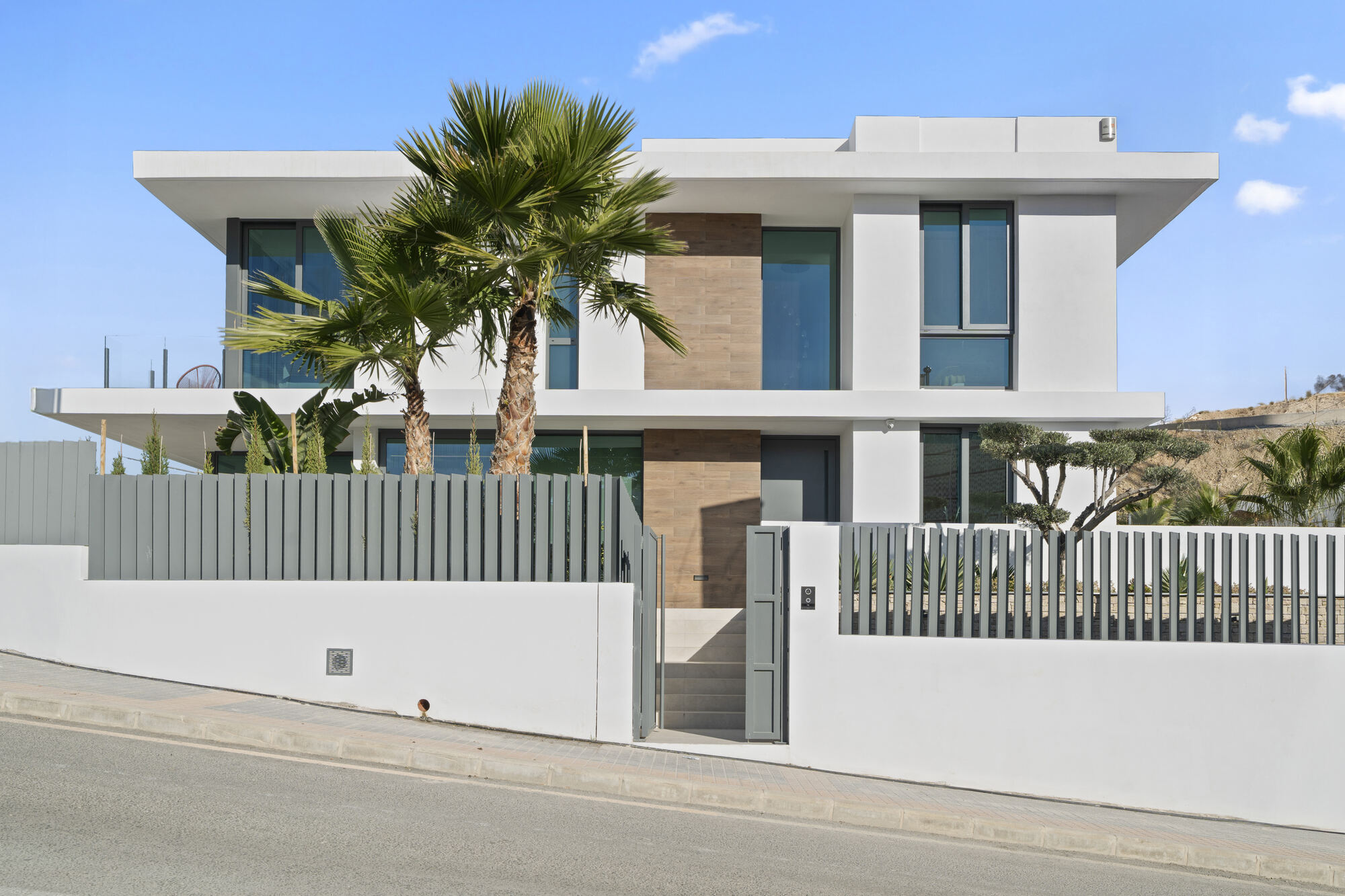
A four-bedroom villa at Villas de Loix starts at €2M before VAT, which is roughly where the new allowance sits.
Four-bedroom villas for sale in Rincón de Loix


The solidarity tax on large fortunes
The Impuesto Temporal de Solidaridad de las Grandes Fortunas is a state tax created by Law 38/2022 for net wealth above €3,000,000 (Law 38/2022, article 3). The key points:
- A fixed €700,000 allowance, then 0% on the first €3M of taxable base, 1.7% up to €5,347,998, 2.1% up to €10,695,996 and 3.5% above. In practice it starts to bite above roughly €3.7M of net wealth.
- The same people pay it as pay wealth tax, residents on worldwide wealth and non-residents on Spanish assets, and the same exemptions apply, including the €300,000 main-home exemption.
- Wealth tax actually paid is deducted, so it only costs extra where the regional wealth tax is lower.
- Regional allowances do not apply, because it is a state tax.
It was meant for 2022 and 2023 only. Royal Decree-law 8/2023 extended it until wealth taxation is reviewed as part of the reform of regional financing, and that review has not happened, so it still applies to 2026. The 2025 return (Form 718) was filed in July 2026 (Agencia Tributaria, June 2026).
Non-resident income tax on a villa you do not rent
A non-resident who keeps a Spanish home for their own use pays income tax on an imputed income, as if the house earned a small rent (Agencia Tributaria, imputed income):
- The income is 2% of the cadastral value shown on the IBI bill, or 1.1% where the town’s cadastral values were revised in a general valuation that took effect from 1 January 2012 (the rule for 2023 to 2026).
- No expenses are deductible. The amount is reduced pro rata for days the villa was rented or not owned, and split between co-owners by share.
- The rate is 19% for residents of the EU, Iceland, Norway and Liechtenstein, and 24% for everyone else, including UK, US and Gulf residents.
- Properties under construction carry no imputed income.
- From 2026 income onwards, Form 210 is filed between 1 April and 31 December of the following year (Agencia Tributaria, Order HAC/623/2026).
This changes in 2027. Royal Decree-law 29/2026, validated by Congress on 12 November 2026, replaces the flat percentages from 1 January 2027 with a scale on the total cadastral value of a person’s non-main homes: 1.1% up to €100,000, 1.5% on the next €400,000, 2% on the next €500,000 and 3% above €1M (Income Tax Law, article 85 as amended; Royal Decree-law 29/2026). Non-residents’ imputed income is calculated under that same income tax rule (Non-Resident Income Tax Law, article 24.5), so expect the scale to reach them too, and ask your adviser how it will be applied.
Worked examples: a €2M villa
Simplified illustrations only. We assume a villa valued for wealth tax at €2,000,000, a cadastral value of €600,000 (the real figure appears on the IBI bill once the villa is registered), no mortgage, 2026 rules unless stated, and full-year ownership. Your own figures will differ.
(a) A non-resident owner living in the UK, villa used only by the family
- Wealth tax: applying the Valencian rules, €2,000,000 minus the €2,000,000 allowance leaves a taxable base of zero, so nothing is payable. A slightly higher value would still require a return, as assets would exceed €2M.
- Solidarity tax: nothing, as net Spanish wealth is below €3M.
- Imputed income tax: €600,000 × 1.1% = €6,600, taxed at 24% = €1,584 a year. At the 2% rate it would be €12,000 × 24% = €2,880. An owner resident in the EU would pay 19%: €1,254 or €2,280.
- Under the 2027 scale: €1,100 + €6,000 + €2,000 = €9,100 of imputed income, so €2,184 at 24% (€1,729 at 19%).
(b) A new resident who makes the villa their main home
Assume €3,000,000 of other net assets worldwide, so total wealth of €5,000,000, and no Beckham regime.
- Main-home exemption: the villa counts as €1,700,000, so net wealth is €4,700,000.
- Wealth tax: minus the €2,000,000 allowance gives a base of €2,700,000. The scale gives €32,255 on the first €2,673,999 plus 2.12% on the remaining €26,001 (€551): about €32,806, before any reduction under the 60% income cap.
- Solidarity tax: €4,700,000 minus €700,000 leaves €4,000,000; 1.7% on the €1,000,000 above €3M is €17,000. The €32,806 of wealth tax paid is deducted, so nothing is due.
- Imputed income: none, because a main home is excluded.
Under the Beckham regime the same person would be taxed for wealth tax only on Spanish assets (Income Tax Law, article 93), which in this example would remove the €3M of foreign assets from the calculation.
What this means when buying at Villas de Loix
Villas de Loix is a group of 27 detached new-build villas with private pools in Rincón de Loix, Benidorm. Three-bedroom villas start at €1,080,000 before 10% VAT, four-bedroom villas from €2M, and the four-bedroom show villa, Villa 26, is listed at €2,149,226 before VAT. Current figures are on our prices and availability page, and the four-bedroom villas page shows the larger plots.
Three practical points follow from the rules above. Completion is estimated for Q2–Q3 2027 (April–September 2027), and a property under construction carries no imputed income, so the first imputed-income return for a non-resident buyer will follow completion and fall under the 2027 rules. Because the price paid sets a floor for the wealth tax value, the contract price is the figure to plan around. And whether you stay non-resident or move here changes the picture more than the choice of villa does, so model both before signing. If you are comparing premium villas for sale in Alicante, these are the villas still available.
Villas available at Villas de Loix, Benidorm


Frequently asked questions
Do non-residents get the Valencian €2M wealth tax allowance?
Yes, if the highest-value part of their Spanish assets is in the Comunitat Valenciana. Non-residents may apply that region’s rules instead of the state allowance of €700,000.
Is the solidarity tax still charged in 2026?
Yes. It was extended indefinitely by Royal Decree-law 8/2023 until wealth taxation is reviewed within the reform of regional financing. It applies above €3M of net wealth, and wealth tax paid is deducted from it.
I rent the villa out for part of the year. Do I still pay imputed income tax?
Only for the days it is not rented. Rental income is taxed separately, and imputed income is reduced in proportion to the days the villa was let.
When does a buyer at Villas de Loix start paying these taxes?
Imputed income does not apply while the villa is being built. Wealth tax is assessed on what you own each 31 December, so take advice on how the stage payments and the completed villa are reported in each year.
This article is general information as of November 2026, not tax or legal advice. The examples are simplified and leave out factors such as other income, debts, double tax treaties and the 60% cap. Tax rules change often, so confirm your position with a Spanish tax adviser before you buy.
